
Traffic sources explained
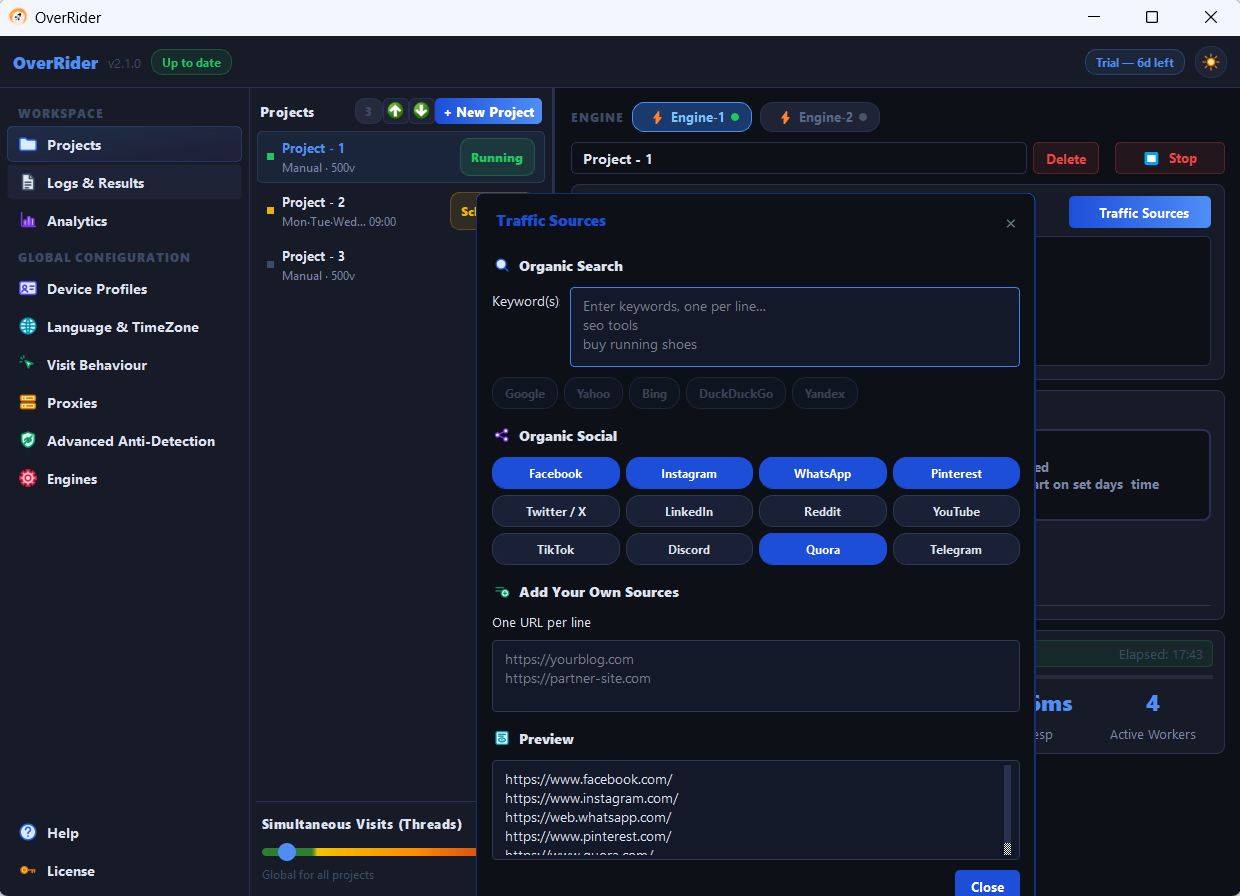
A traffic source is a referrer page the browser visits before your site, which is what makes analytics assign a source and medium. OverRider offers organic search across five engines, twelve social platforms, and any custom URLs you supply. Sources and target URLs are chosen independently, so keywords are never tied to specific pages.
Without a traffic source, visits arrive with no referrer and your analytics records them as direct. A traffic source is simply a page the browser loads before yours, so the visit arrives carrying a real referrer.
How it works
When a project has traffic sources, each visit:
- Loads the referrer page and waits there for 15 to 60 seconds, scrolling and moving the mouse.
- Navigates to your target URL.
Your analytics sees the referrer and categorises the session accordingly — a Google search URL becomes organic search, a social platform becomes social, and a custom URL becomes a referral from that domain.
Organic search
You enter keywords, and OverRider builds a search results URL for each keyword on each engine you tick:
| Engine | Referrer produced |
|---|---|
google.com/search?q=<keyword> | |
| Yahoo | search.yahoo.com/search?p=<keyword> |
| Bing | bing.com/search?q=<keyword> |
| DuckDuckGo | duckduckgo.com/?q=<keyword> |
| Yandex | yandex.com/search/?text=<keyword> |
Keywords and engines multiply. Five keywords across three engines produce fifteen referrer URLs, and one is picked at random per visit.
This is not a search-ranking tool, and any effect on rankings is not guaranteed. The browser loads a search results page as a referrer; it does not search for you, find your listing, or click it. The direct effect is only on how your own analytics labels the visit.
Organic social
Tick any of twelve platforms to use their home page as the referrer: Facebook, Instagram, WhatsApp, Pinterest, Twitter / X, LinkedIn, Reddit, YouTube, TikTok, Discord, Quora and Telegram.
No keyword is involved — the platform’s own URL is the referrer.
Custom sources
You can add any URL as a referrer. Use this for a partner site, a newsletter landing page, or a specific article that links to you. The page must be publicly reachable, because the browser genuinely loads it.
Keywords are not tied to URLs
This is the most common misunderstanding. For each visit OverRider picks a target URL at random and a referrer at random, independently. There is no pairing between them.
With three keywords and three landing pages you get nine possible combinations, not three matched pairs. If you need a specific keyword to always accompany a specific page, create a separate project for each pairing.
Referrer pages must load
The referrer is a real navigation, so it can fail. If the referrer page returns an error — a proxy authentication failure, a rate limit, or a block — the whole visit is treated as failed and retried with a different proxy, rather than being logged as a success.
Loading a referrer adds 15 to 60 seconds to every visit. If your visits-per-hour rate is lower than you expected, this is usually why. See Spread visits gradually over several hours.
Checking what will be used
The Traffic Sources dialog has a Preview listing every referrer URL your current settings produce. Check it before starting a long run — a typo in a keyword is much easier to catch here than in your analytics tomorrow.
Last updated: